
Sound Sampler turns an Android phone into a pad rig you can shape to taste. Drop in your own media—short WAVs, MP3 stingers, even a video or a direct URL—map each one to a colored pad, and trigger them with a tap. Every pad can behave differently, so the board feels like a small instrument rather than a static file list.
How It Works In Practice
Flip on Edit Mode, touch a pad, and point it to a file from storage or paste a link. Give the pad a clear name, set how it should react, trim the start and end, and nudge level, pan, pitch, and speed until it sits right. Exit Edit Mode and play. Do the same for as many pads as you need, then save the whole layout as a configuration.
Why People Enjoy Using It
Small adjustments change everything. A 120 ms fade-in removes the click from a harsh sample. A touch of ping-pong pan adds movement to a static hit. Cropping a long clip into a tight one-shot makes it usable on stage. A few thoughtful pads quickly become a dependable board for streams, classes, theatre cues, or quick beat sketches.
Feature Highlights
- Bring-your-own media: audio, video, MIDI, plus the option to use a direct URL.
- Pad behaviors: one-tap start / second-tap stop, momentary (plays while pressed), loop-while-held, and start–pause–resume.
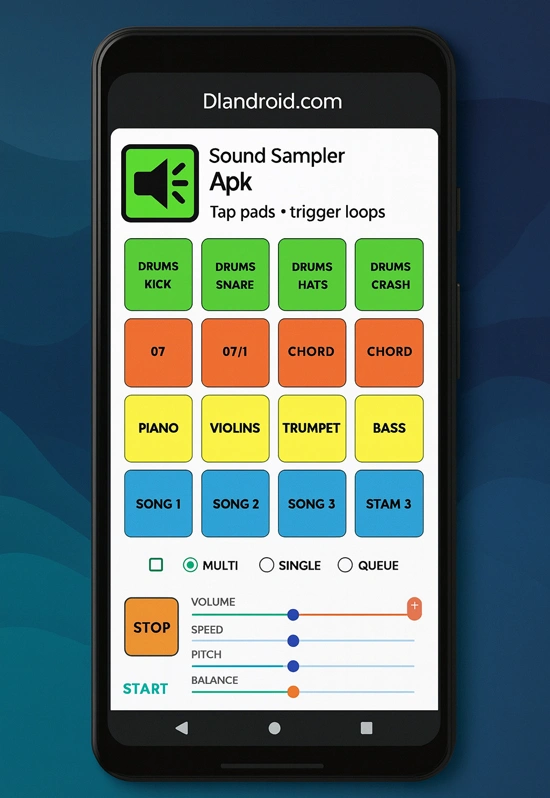
- Sound modes: Multi-Layer (stack pads), Single-Layer (one at a time), and Queue (orderly playback).
- Queue styles: Prime, Parallel, and Fasttrack for clean, timed sequences.
- Per-pad control: volume, balance, pitch, speed, crop, fade-in/out, stop-fade, and ping-pong panning.
- Commands & scripts: trigger several pads together or run a programmed sequence.
- Layout freedom: choose pad count, drag to rearrange, rename on the fly, export/import full boards.
- Master controls: global volume, pitch, speed, plus simple low/high-shelf filters.
First Setup
- Menu → Edit Mode.
- Choose a pad → Select File (local or URL) → set a clear name and a behavior.
- Crop the section you want and set fade lengths in milliseconds.
- Adjust level, pan, pitch, and speed → exit Edit Mode and test.
Playback Modes Explained
- Multi-Layer: stack sounds (ambience beds with stingers on top).
- Single-Layer: one sound at a time (clean cueing for classes or shows).
- Queue: clips fire in sequence; the next begins when the previous finishes.
Pad Colors At A Glance
- Green: tap once to play.
- Blue: tap to play, tap again to stop.
- Red: plays while held, stops on release.
- Yellow: loops while held, stops on release.
- Orange: start → pause → resume with taps.
Editing Toolkit
- Time formats:
hh:mm:ss.mmm(e.g., 0:12.640) orseconds.milliseconds(e.g., 12.640). - Fades for smooth entries/exits; stop-fade for natural endings.
- Ping-pong adds gentle left–right motion on a single pad.
- Reset [R] beside master knobs snaps values back to default.
Real-World Setups
- Streaming: map memes, alerts, and scene stingers to separate colors.
- Teaching: one row for examples, one for quiz cues, one for timers.
- Theatre: atmospheres in Queue, critical cues in Single-Layer.
- Beatmaking: momentary drum one-shots plus looped textures underneath.
Speed & Flow Tips
- Keep files lean for snappy triggers.
- Use Single-Layer for strict cueing; switch to Multi-Layer when you need stacked hits.
- Save multiple configurations—live board, studio board, and a teaching board.
Premium / Mod Build Scope
Everything above is present, with additional unlocked options for faster setup, deeper control over pad behavior and scripted sequences, and full export/import for moving boards between devices or sharing with collaborators.
Android Setup
- Download Sound Sampler APK (Android 7.0+ recommended).
- Temporarily allow install from your browser or file manager while setting up.
- Launch the app, create a configuration, and start mapping pads.
Updates & Maintenance
This page follows current releases so names of modes, pad behaviors, and setup steps match the latest build of Sound Sampler, including Sound Sampler Mod APK and Sound Sampler Premium APK variations.
Who This Page Serves
People searching for Sound Sampler APK, Sound Sampler Mod APK, or Sound Sampler Premium on Android; creators who prefer a flexible pad-based workflow without a full DAW; anyone who needs reliable audio cues for streams, lessons, podcasts, or small stage shows.


Leave a Reply