The volume keys are among the few physical controls left on most Android phones, yet they usually perform just one basic task. Button Mapper: Remap your keys APK Mod Pro gives those buttons a second purpose by assigning separate actions to a normal press, double tap, or long press.
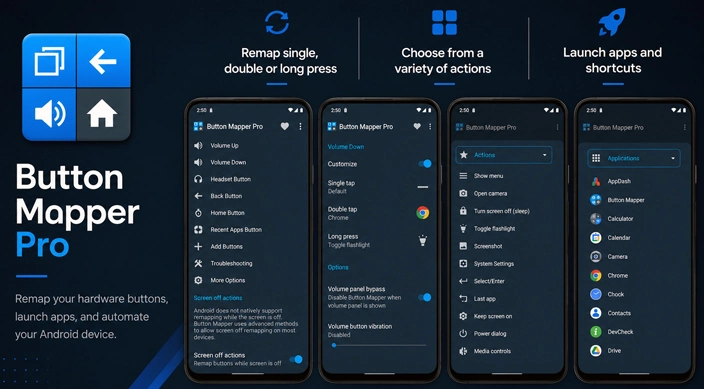
You could keep the usual volume control, double-press the same key to open the camera, and hold it down to switch on the flashlight. Nothing needs to change on the home screen, and there is no extra shortcut taking up space. The commands remain attached to buttons that are already within reach.
The most useful mappings are often the simplest ones. Holding the volume down could activate Do Not Disturb before a meeting. Two quick presses might open a music player, launch the calculator, or return to a frequently used app. Small changes like these remove several taps from actions repeated throughout the day.
One Button, Several Everyday Shortcuts
Each supported key may respond differently depending on the way it is pressed. Its original function can remain active while the double-tap and long-press gestures handle two additional commands.
Button Mapper includes actions for screenshots, notifications, screen rotation, brightness, mute, split screen, recent apps, Wi-Fi, Bluetooth, and media playback. Installed applications and compatible app shortcuts may also be assigned directly to a button.
Physical controls are particularly convenient for music. Tracks can be paused, skipped, restarted, or muted without opening the player. A headset key may also work as a camera shutter, which is handy when the phone is mounted on a stand or positioned too far away for comfortable screen access.
Not every button needs a replacement action. Unwanted inputs from a headset, remote, or controller may simply be disabled. This helps with accessories that contain awkwardly placed keys or send accidental commands during normal use.
Press timing is adjustable too. A fast double tap may feel right on a phone but less comfortable on a television remote. Changing the double-tap interval and long-press duration makes each control easier to trigger without repeating the action by mistake.
Remotes, Gamepads, and Headset Controls
Support extends beyond the volume buttons built into a smartphone. Many Android TV remotes, Bluetooth gamepads, wired headsets, keyboards, and other connected devices provide additional keys that may be detected and remapped.
A spare remote button could open a streaming service instead of doing nothing. A controller key might launch another app after a game is closed. Headset controls can be arranged around music playback, camera access, or another task that makes more sense for the accessory.
Hardware support depends on how Android identifies each connected device. Some remotes expose nearly every key, while others provide only a limited selection. The same applies to gamepads and headsets, so the number of usable controls will differ between models.
Pro features add custom vibration feedback, themes, pocket detection, orientation-based volume key swapping, broadcast intents, scripts, and custom keycodes. These tools suit more specific setups where a regular app shortcut is not enough.
Mappings may also be paused inside selected apps. A system-wide shortcut could be disabled while a game is open, allowing the button to return to its original in-game function. This prevents a useful Android command from interfering with controls elsewhere.
ADB, Accessibility, and Hardware Limits
Many common shortcuts work without root access. Android still restricts deeper functions, including simulated keycodes, some navigation commands, scrolling actions, scripts, and root commands. Enabling those options may require root permission or an ADB command entered from a connected computer.
Button actions may stop responding while the display is completely off unless the required ADB setup or root access has been applied. This restriction matters for anyone planning to trigger commands without first waking the phone.
The Accessibility service must remain enabled because it detects presses from supported physical and capacitive keys. On phones with aggressive battery management, background restrictions may also need to be removed so Android does not close the service after a period of inactivity.
Touchscreen navigation controls, software buttons, and the physical power key are not normally available for remapping. Phones with capacitive Home, Back, or Recent buttons naturally provide more built-in options than devices that rely entirely on gesture navigation.
Using a mapped action to lock the display requires Device Administrator permission. This access is used for the screen-off command and should be removed through the app settings before uninstalling Button Mapper.
Filling every available key with a different command is rarely necessary. Two or three memorable shortcuts usually provide a better experience than a crowded setup that becomes difficult to remember. Once the chosen actions feel familiar, opening the camera, controlling music, or reaching a common Android setting takes a button press instead of several screen taps.



Version 1.51 available
done
1.46
done